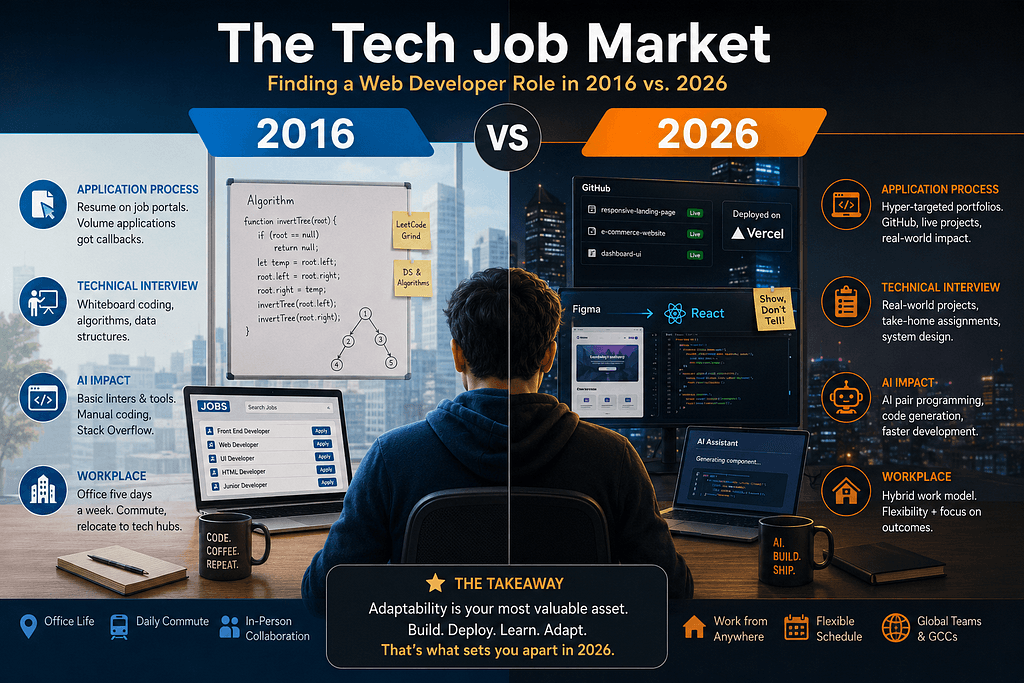
As a web developer with nearly seven years of experience under my belt, I’ve had a front-row seat to one of the most dramatic shifts in software engineering history. When I was first dipping my toes into the industry, the landscape was entirely different. Today, as we navigate 2026, the rules of the game have been completely rewritten.
If you’re looking at the domestic tech job market — especially in the massive, highly competitive tech hubs across South Asia — you already know that the days of simply throwing a basic resume onto a major job board and waiting for the phone to ring are long gone.
Here is a deep dive into how finding a tech job has evolved from 2016 to 2026, and what it means for developers trying to stand out today.
1. The Application Process: From Spray-and-Pray to Hyper-Targeted Portfolios
In 2016: The volume game worked. You could build a generic resume highlighting HTML, CSS, JavaScript, and maybe some early React or Angular experience, upload it to traditional portals, and reliably get callbacks. The talent pool was large, but the filtering mechanisms were primitive. Recruiters relied heavily on keyword matching.
In 2026: The application process is a completely different beast. With the rise of AI-driven applicant tracking systems (ATS), a generic resume will never see human eyes. Furthermore, the massive influx of computer science graduates in the region means you are competing against thousands of applicants for a single mid-level position.
Instead of just a resume, employers expect a living portfolio. For front-end and web developers, this means active GitHub repositories showcasing real-world deployments. You need to prove you can build responsive, production-ready applications, not just follow a tutorial.
2. The Technical Interview: Whiteboards vs. Real-World Execution
In 2016: The technical interview was famously grueling but predictable. You walked into a room, picked up a dry-erase marker, and spent 45 minutes trying to invert a binary tree or solve complex algorithmic puzzles on a whiteboard. It was the era of grinding “LeetCode” for months. The focus was on rote memorization of data structures, even if you were applying for a UI/UX-heavy web development role.
In 2026: The interview process has evolved to mirror actual daily work. Companies have realized that knowing how to reverse a linked list from memory doesn’t mean you can build a scalable web app.
Today, you are far more likely to face a practical take-home assignment. For example, to get past the technical screening for modern hybrid roles in major tech capitals, it is completely standard to be asked to design and deploy a responsive React landing page, matching pixel-perfect Figma layouts, and pushing the code to a Git repository. They want to see how you structure your components, how you handle state, and how you consume APIs — the exact things you’ll be doing on the job.
3. The Impact of AI: Autocomplete to Autonomous Agents
In 2016: “AI” in web development meant maybe having a slightly smarter code linter. We wrote boilerplate code manually, spent hours hunting down missing semicolons, and relied heavily on Stack Overflow to debug obscure framework errors.
In 2026: AI has fundamentally altered what a web developer is expected to do. AI coding assistants are fully integrated into our IDEs. Because AI can generate boilerplate, scaffold applications, and even write basic test coverage in seconds, the entry-level tasks that used to go to junior developers have vanished.
The market has shifted into a “barbell” shape: there is a massive glut of junior applicants struggling to break in, while demand for senior developers — who possess the architectural judgment to review, secure, and integrate AI-generated code — is absolutely skyrocketing. As a mid-to-senior developer today, your value isn’t in how fast you can type code, but in your system design skills and your ability to orchestrate AI tools to ship faster.
4. The Workplace: The Office Era vs. The Hybrid Reality
In 2016: Remote work was a rare perk reserved for a select few freelancers. If you wanted a serious tech job, you had to pack up and physically relocate to one of the major metropolitan tech corridors. You went into the office five days a week, sat in an open-plan layout, and dealt with the daily commute.
In 2026: While the fully-remote tech boom of the early 2020s has pulled back slightly, the hybrid model is now the undisputed king. Global companies are increasingly establishing massive Global Capability Centers (GCCs) across our domestic tech hubs to tap into local senior talent. You are expected to be mobile and willing to relocate to these cities for hybrid employment opportunities, but the flexibility of working from home a few days a week is permanently baked into the culture.
The Takeaway for Developers in 2026
If there’s one lesson I’ve learned over the last 6–7 years, it’s that adaptability is your most valuable asset. The developers who are thriving in 2026 aren’t necessarily the ones who memorized the most algorithms back in 2016. They are the ones who embraced React when it took over, learned to utilize AI instead of fearing it, and can prove their skills by deploying functional, well-architected applications.
The competition is fiercer than ever, but for those who focus on real-world execution and architectural judgment, the opportunities have never been bigger.