We’ve all seen the headlines: “Developer builds AI wrapper in a weekend, hits $50k MRR.”
It makes for great social media fodder, but after spending nearly seven years in the trenches of web development, I’ve noticed a persistent industry paradox. We spend 90% of our online discourse arguing about bleeding-edge frameworks, micro-optimizations, and the newest shiny tools — yet 90% of the software that actually runs the global economy is built on what most junior developers would call “boring” architecture.
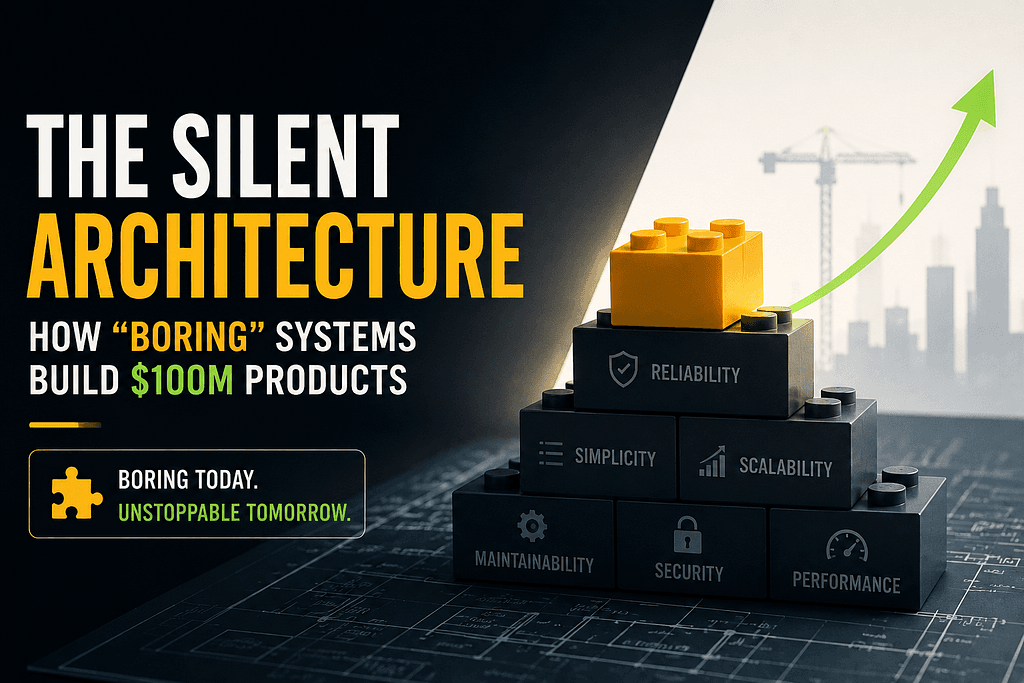
If you want to grow from a mid-level coder who builds cool features into a senior engineer who commands serious value, you have to understand the Silent Architecture.
Here is why embracing “boring” technical decisions is the secret weapon for building scalable, high-revenue products in 2026 — and why trying to be too clever is killing your software.
1. Innovation Tokens: Spend Them Wisely
There’s a famous concept originally coined by Dan McKinley called Innovation Tokens. Imagine you only get three innovation tokens per software project. Every time you choose an unproven database, a bleeding-edge state management library, or a brand-new deployment architecture, you spend a token.
When you run out of tokens, your project collapses under the weight of its own operational complexity.
- The Trap: Early-career developers often try to maximize their resume keyword density on every project. They use a complex microservices architecture for a product that has 500 active users, simply because it’s trending.
- The Reality: The most profitable products use a battle-tested monolith, standard relational databases (like PostgreSQL), and straightforward server-side rendering or clean, modular REST/GraphQL APIs. They save their “Innovation Tokens” for their actual core product differentiator — like proprietary AI workflows or unique user experiences.
2. The Cost of “Clever” Code
Early in my career, I prided myself on writing clever code — one-line array mutations, deeply nested ternary operators, and custom abstractions that felt like wizardry.
Seven years later, my definition of good code is completely opposite: Good code is code that a tired developer can understand at 2:00 AM during a production outage.

When you’re building teams — especially in hybrid engineering environments where collaboration happens across time zones — readability and predictability trump cleverness every single time.
3. The Real Performance Bottleneck Isn’t Your Framework
We love framework wars. In 2016, it was Angular vs. React. Today, we still argue over bundle sizes down to the kilobyte.
But when you actually profile production applications at scale, 99% of user-facing performance issues have nothing to do with whether you used React, Vue, or a lightweight alternative. They come down to:
- Unoptimized Network Waterfalls: Fetching data sequentially instead of in parallel.
- Database Inefficiency: Missing indexes, N+1 query problems, and fetching columns you never render.
- Architectural Latency: Poor caching strategies and failing to understand how data moves between the client and the server.
You can write the cleanest, most modern front-end code in the world, but if your API takes 1,200ms to return a payload because of a poorly structured database query, your user experience is broken.
4. AI-Resistant Engineering: Why Systems Thinking Wins
In 2026, AI coding assistants can generate a functional UI component or write CRUD boilerplate in seconds. Because of this, the market value of purely mechanical coding has dropped.
However, AI is notoriously bad at holistic systems thinking. It doesn’t know:
- Where your system’s data boundaries should live to prevent future bottlenecks.
- How to gracefully degrade a service when a third-party payment gateway goes down.
- How to balance technical debt against a tight business deadline.
The developers who are thriving right now aren’t just “writers of code” — they are product architects. They understand how a front-end decision impacts database load, how user onboarding flows affect conversion rates, and how to design systems that don’t require a 10-person DevOps team just to keep the servers running.
The Takeaway
Next time you start a new project or propose an architectural change at work, resist the urge to reach for the newest, shiniest tool just for the sake of it.
Ask yourself: “What is the simplest, most boring, most robust way I can solve this user’s problem?”
Mastering the boring stuff isn’t giving up on innovation — it’s building a foundation strong enough to actually support it.
We’ve all seen the headlines: “Developer builds AI wrapper in a weekend, hits $50k MRR.”
It makes for great social media fodder, but after spending nearly seven years in the trenches of web development, I’ve noticed a persistent industry paradox. We spend 90% of our online discourse arguing about bleeding-edge frameworks, micro-optimizations, and the newest shiny tools — yet 90% of the software that actually runs the global economy is built on what most junior developers would call “boring” architecture.
If you want to grow from a mid-level coder who builds cool features into a senior engineer who commands serious value, you have to understand the Silent Architecture.
Here is why embracing “boring” technical decisions is the secret weapon for building scalable, high-revenue products in 2026 — and why trying to be too clever is killing your software.
1. Innovation Tokens: Spend Them Wisely
There’s a famous concept originally coined by Dan McKinley called Innovation Tokens. Imagine you only get three innovation tokens per software project. Every time you choose an unproven database, a bleeding-edge state management library, or a brand-new deployment architecture, you spend a token.
When you run out of tokens, your project collapses under the weight of its own operational complexity.
- The Trap: Early-career developers often try to maximize their resume keyword density on every project. They use a complex microservices architecture for a product that has 500 active users, simply because it’s trending.
- The Reality: The most profitable products use a battle-tested monolith, standard relational databases (like PostgreSQL), and straightforward server-side rendering or clean, modular REST/GraphQL APIs. They save their “Innovation Tokens” for their actual core product differentiator — like proprietary AI workflows or unique user experiences.
2. The Cost of “Clever” Code
Early in my career, I prided myself on writing clever code — one-line array mutations, deeply nested ternary operators, and custom abstractions that felt like wizardry.
Seven years later, my definition of good code is completely opposite: Good code is code that a tired developer can understand at 2:00 AM during a production outage.
The “Clever” ApproachThe “Boring” (Senior) ApproachCustom-built state machine from scratchStandard, heavily documented libraryHighly abstracted, 1-line functional chainsClear, step-by-step imperative logic with readable variable names “Self-documenting” code with zero commentsClear architectural Readmes and explicit comments explaining the why, not the what
When you’re building teams — especially in hybrid engineering environments where collaboration happens across time zones — readability and predictability trump cleverness every single time.
3. The Real Performance Bottleneck Isn’t Your Framework
We love framework wars. In 2016, it was Angular vs. React. Today, we still argue over bundle sizes down to the kilobyte.
But when you actually profile production applications at scale, 99% of user-facing performance issues have nothing to do with whether you used React, Vue, or a lightweight alternative. They come down to:
- Unoptimized Network Waterfalls: Fetching data sequentially instead of in parallel.
- Database Inefficiency: Missing indexes, N+1 query problems, and fetching columns you never render.
- Architectural Latency: Poor caching strategies and failing to understand how data moves between the client and the server.
You can write the cleanest, most modern front-end code in the world, but if your API takes 1,200ms to return a payload because of a poorly structured database query, your user experience is broken.
4. AI-Resistant Engineering: Why Systems Thinking Wins
In 2026, AI coding assistants can generate a functional UI component or write CRUD boilerplate in seconds. Because of this, the market value of purely mechanical coding has dropped.
However, AI is notoriously bad at holistic systems thinking. It doesn’t know:
- Where your system’s data boundaries should live to prevent future bottlenecks.
- How to gracefully degrade a service when a third-party payment gateway goes down.
- How to balance technical debt against a tight business deadline.
The developers who are thriving right now aren’t just “writers of code” — they are product architects. They understand how a front-end decision impacts database load, how user onboarding flows affect conversion rates, and how to design systems that don’t require a 10-person DevOps team just to keep the servers running.
The Takeaway
Next time you start a new project or propose an architectural change at work, resist the urge to reach for the newest, shiniest tool just for the sake of it.
Ask yourself: “What is the simplest, most boring, most robust way I can solve this user’s problem?”
Mastering the boring stuff isn’t giving up on innovation — it’s building a foundation strong enough to actually support it.