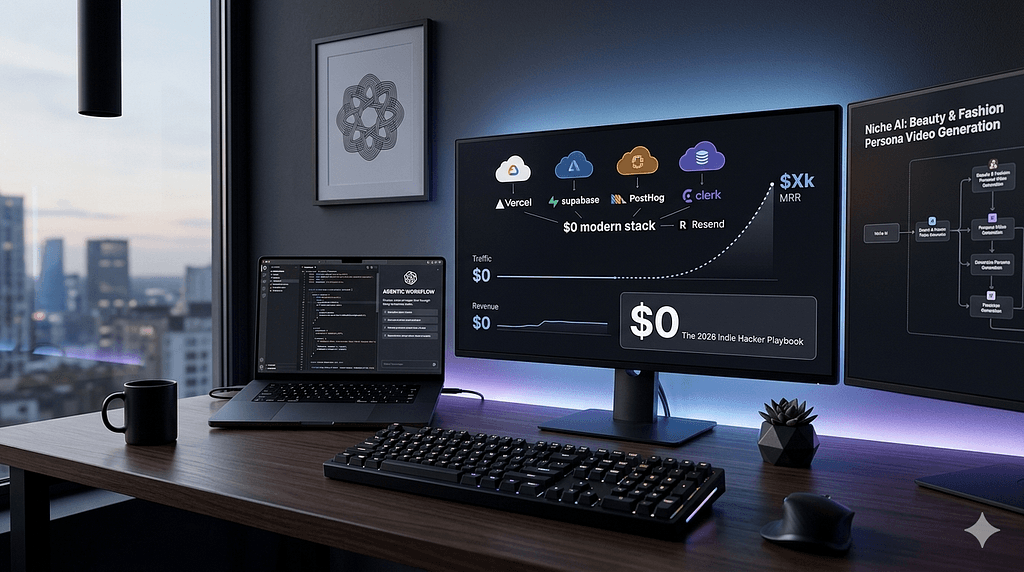
If you have been paying attention to the indie hacker community lately, you already know the truth: indie hacking in 2026 is completely different than it was even three years ago.
Coding is no longer the bottleneck. The competitive advantage has moved away from writing boilerplate code and shifted entirely toward distribution, positioning, and workflow design.
As someone who spends my days deep in modern JavaScript ecosystems, I’ve seen this shift firsthand. A solo builder can now launch a SaaS MVP in days, or a workflow automation in minutes. Speed is one of the biggest advantages we have right now.
Here is a look at the exact stack and strategies I’m seeing — and using — to ship scalable products for literally $0 this year.
The $0 Tech Stack to Reach Product-Market Fit
The tools landscape has changed dramatically, and free tiers are more generous than ever, allowing you to easily scale an application to product-market fit without spending a dime.
If you are starting a project today, this is the blueprint:
- Frontend & Hosting: Deploying a Next.js or React application on Vercel or Netlify provides zero-configuration deployments and generous bandwidth.
- Database: Supabase has cemented itself as the go-to open-source Firebase alternative, offering a robust PostgreSQL database with a 500MB free tier.
- Analytics: Don’t skip your metrics. PostHog offers a massive 1 million events on its free tier, giving you a full open-source analytics suite out of the box.
- Authentication & Email: Clerk handles modern React-first authentication seamlessly (free up to 10K MAU), while Resend offers a developer-friendly API for transactional emails.
AI-First Development Workflows
AI has moved well past the “interesting experiment” stage. According to recent data, over 70% of developers are now using AI-assisted coding tools daily. AI is no longer optional; it is practically the operating system of modern software development.
I rely heavily on tools like GitHub Copilot and Google’s Project IDX in my own workflow. We are moving toward agentic workflows where developers act more like architects. Instead of manually typing out every line of a complex Tailwind CSS layout or a Next.js API route, these tools suggest entire functions, trace data flow, and surface edge cases. The tools don’t write perfect code, but they shift your energy away from mechanical typing and toward system structure and user experience.
Niche Workflows Beat General AI
There is a crucial lesson that many failing startups are learning the hard way right now: AI features are weak, but AI workflows win.
The market for generic “AI assistants” is completely saturated. But niche AI tools that remove manual steps in real workflows are absolutely thriving.
I am currently managing a project focused on generating highly consistent digital personas with exact facial features for beauty and fashion video content. This is a perfect example of a niche application. Instead of building a generic image generator, focusing on a highly specific, high-end cinematic use-case gives you clearer messaging, stronger positioning, and easier distribution. Small products solving highly specific problems are where the massive wins are happening.
Final Thoughts
If there is one takeaway for 2026, it is this: Ideas are cheap, and thanks to modern tooling, code is cheap too.
The real, defensible skill today is understanding a user’s actual pain points and shipping a solution incredibly fast. Grab a Next.js boilerplate, fire up your AI assistant, plug into Supabase, and get your MVP out the door by the end of the week.
Let’s keep building.