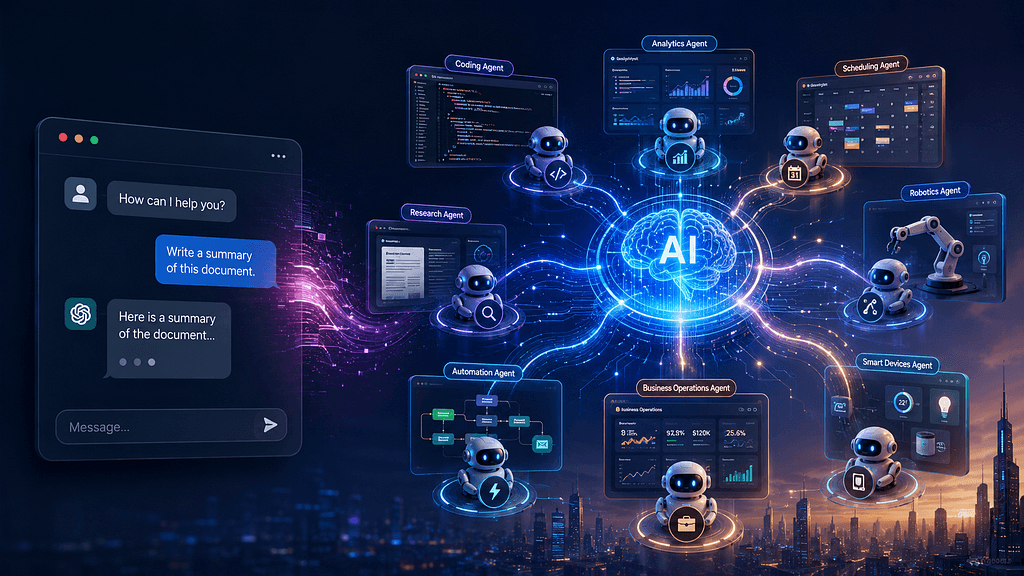
For the last couple of years, the tech world has been captivated by Generative AI. We’ve grown accustomed to typing prompts into chatboxes and marveling as they instantly generate essays, code snippets, and hyper-realistic images.
But as powerful as standard Large Language Models (LLMs) are, they share one fundamental limitation: they are entirely passive. They sit and wait for your exact instructions, answer your question, and then go back to sleep.
The industry is now moving past this passive phase. The next major frontier — and the topic driving massive search volumes across the tech sector right now — is Autonomous AI Agents.
What Exactly is an Autonomous AI Agent?
An AI agent is a system that doesn’t just generate text; it executes multi-step goals. You give it an objective, and the agent breaks that objective down into tasks, figures out which digital tools it needs to use, executes those tasks, evaluates the results, and course-corrects if something goes wrong.
Think of a standard LLM as a highly intelligent consultant who gives you great advice. An AI agent, on the other hand, is like an intern who takes that advice, logs into your software, and actually does the work for you.
The Shift: From “Thinkers” to “Doers”
To understand why this is trending so heavily, we have to look at how agents change the software paradigm. Agents rely on a framework often called “Agentic Workflow.” This involves:
- Reasoning: The AI assesses the overall goal and plans a logical sequence of actions.
- Tool Usage: The AI is given access to external APIs. It can search the web, execute Python code, read a database, or send an email.
- Memory: The AI remembers past interactions and learns from its mistakes during the execution loop.
- Autonomy: It loops through these steps without requiring human intervention for every single prompt.
Where Are We Seeing This in Action?
The leap from conceptual to practical is happening incredibly fast. Here are a few areas where AI agents are already making waves:
- Software Engineering (Devin & Open Devin): We are seeing the rise of AI software engineers that can take a prompt like “build a weather app,” independently write the code, run a testing environment, debug the errors, and deploy it.
- Autonomous Research: Instead of you Googling 20 different articles to compile a report, a research agent can autonomously browse the web, scrape the relevant data, verify the sources, and format it into a comprehensive document.
- Customer Success: Beyond basic chatbots, agentic systems can now look up a user’s order history, interact with the shipping API to reroute a package, and proactively email the customer the update.
The Road Ahead
We are transitioning from software as a tool to software as a collaborator. While standard AI gave us the ability to generate information at scale, Autonomous AI Agents are giving us the ability to generate action at scale.
As these systems become more reliable and their reasoning capabilities deepen, the question will no longer be “What can AI write for me?” but rather, “What can AI execute for me today?”
Would you like to explore how developers are actually building these agents, or would you prefer to dive into the security and privacy implications of giving AI this kind of autonomy?
#AutonomousAI #AIAgents #AgenticAI #FutureOfTech #ArtificialIntelligence #TechTrends #AgenticWorkflows #TechInnovation #MachineLearning