
In 2026, web development is shifting from “write every line yourself” to “architect, review, ship, and improve with AI.”
A few years ago, AI in development felt like a fancy autocomplete tool.
Today, it is becoming something much bigger.
AI can now explain code, generate components, review pull requests, write tests, suggest architecture, debug errors, and even work on GitHub issues in the background. GitHub’s Copilot coding agent, for example, can be assigned a task or issue, work in a development environment, and submit its changes as a pull request for review.
As a web developer, I don’t see this as the end of developers.
I see it as the beginning of a new kind of developer.
The old question was:
“Can you write code?”
The new question is:
“Can you understand the problem, design the right solution, guide AI properly, review the output, and ship reliable software?”
That difference matters.
AI Is Becoming a Normal Part of Development
AI is no longer something only experimental developers use. According to the 2025 Stack Overflow Developer Survey, 84% of respondents are using or planning to use AI tools in their development process, and 51% of professional developers use AI tools daily.
That means AI-assisted development is not a future trend.
It is already here.
But here is the important part: using AI does not automatically make someone a better developer.
A weak developer with AI may generate more code, but also more bugs.
A strong developer with AI can move faster because they know what to ask, what to reject, what to refactor, and what to test.
That is where the real advantage is.
The Web Developer’s Role Is Changing
Earlier, many developers spent most of their time writing boilerplate code.
Navbar. Footer. Form validation. API call. Loading state. Error state. Dashboard card. Authentication flow.
These things are still important, but they are no longer the full measure of a developer’s value.
AI can help generate the first version of many of these tasks.
But AI still needs direction.
It needs someone to define:
What should the user experience feel like?
Which framework is best for the project?
How should the data flow?
What should happen when the API fails?
Is this component reusable?
Is the code secure?
Will this scale?
Is the UI accessible?
Does this actually solve the business problem?
This is where human developers become more valuable, not less.
TypeScript, AI, and the New Web Stack

One interesting shift is the rise of TypeScript.
GitHub’s Octoverse 2025 report says AI, agents, and typed languages are driving one of the biggest changes in software development in more than a decade. It also reported that TypeScript became the most-used language on GitHub by monthly contributors.
This makes sense.
AI works better when the codebase gives it more structure.
TypeScript provides types, contracts, interfaces, and better context. When AI understands the shape of your data and components, it can generate more accurate code.
For web developers, this is a signal.
Learning React is good.
Learning Next.js is good.
But learning React + TypeScript + clean architecture + AI-assisted workflow is much more powerful.
That combination can help developers build faster without losing control over quality.
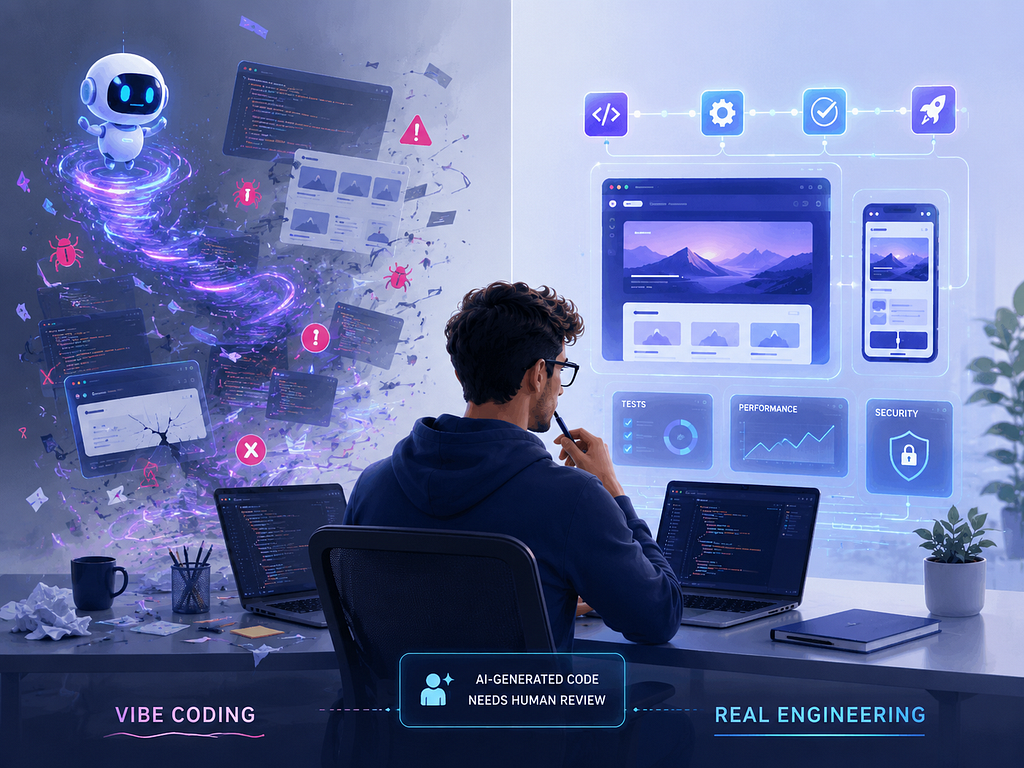
The Future Is Not “Vibe Coding”
There is a lot of hype around “vibe coding.”
You write a prompt, AI generates an app, and everything looks magical.
But real development is different.
Real projects have edge cases.
Clients change requirements.
Users behave unexpectedly.
APIs fail.
Payments break.
SEO matters.
Performance matters.
Security matters.
Accessibility matters.
A production-ready web app is not just a collection of generated components. It is a system.
That is why I believe the best developers in 2026 will not be the ones who blindly depend on AI.
They will be the ones who use AI like a junior assistant.
Fast, useful, sometimes impressive — but still requiring review.
How I Think Developers Should Use AI
The best way to use AI is not to ask:
“Build my entire app.”
A better approach is:
“Help me create the first version, then help me improve it step by step.”
For example, a web developer can use AI to:
Generate layout ideas
Create reusable React components
Convert UI into responsive HTML/CSS
Write TypeScript interfaces
Debug errors
Improve SEO metadata
Optimize page performance
Write test cases
Refactor messy code
Review security issues
Explain unfamiliar code
This workflow saves time.
But the developer still owns the final result.
That ownership is important.
AI can assist, but the developer is responsible for what gets shipped.
AI Agents Are the Next Big Shift

The next stage of AI development is not just chat-based coding.
It is agent-based coding.
GitHub introduced the Copilot app as an “agent-native desktop experience” at Microsoft Build 2026, showing how the industry is moving toward AI agents that can work across tasks, codebases, and development workflows.
This is a big shift.
Instead of asking AI one question at a time, developers may soon manage multiple AI agents working on different tasks.
One agent fixes bugs.
Another writes tests.
Another improves documentation.
Another reviews performance.
But again, someone has to manage the process.
That someone is the developer.
The future developer may look less like a person typing code all day and more like a technical director: planning, guiding, reviewing, and shipping.
What Web Developers Should Learn Now
If you are a web developer and want to stay relevant, do not panic.
But do upgrade your skills.
Focus on these areas:
1. JavaScript and TypeScript fundamentals
Frameworks change, but fundamentals stay useful.
2. React and Next.js architecture
Do not just learn components. Learn routing, rendering, data fetching, caching, and performance.
3. UI/UX thinking
AI can generate screens, but users judge experience.
4. Prompting for development
A good prompt is not just a sentence. It is a clear technical instruction with constraints.
5. Code review skills
AI-generated code must be reviewed carefully.
6. Security basics
Never trust code blindly, especially authentication, payments, file uploads, and user data.
7. SEO and performance
A beautiful website that nobody finds or that loads slowly is still a weak website.
My Personal Take
As a web developer, I am not worried that AI will replace developers.
I am more worried about developers who refuse to adapt.
The developer who says, “AI is useless,” may fall behind.
The developer who says, “AI will do everything for me,” may ship poor-quality work.
But the developer who says, “AI can help me build faster, while I stay responsible for quality,” will have a serious advantage.
That is the mindset I believe we need.
The future of web development is not human vs AI.
It is human direction plus AI speed.
And the developers who understand that will build better products, faster.
Final Thought
AI is changing web development, but it is not removing the need for skill.
It is raising the standard.
Clients will expect faster delivery.
Teams will expect better productivity.
Users will expect smoother experiences.
And developers will need to become better problem-solvers, not just better code writers.
The best time to start learning AI-assisted development was yesterday.
The second-best time is today.